
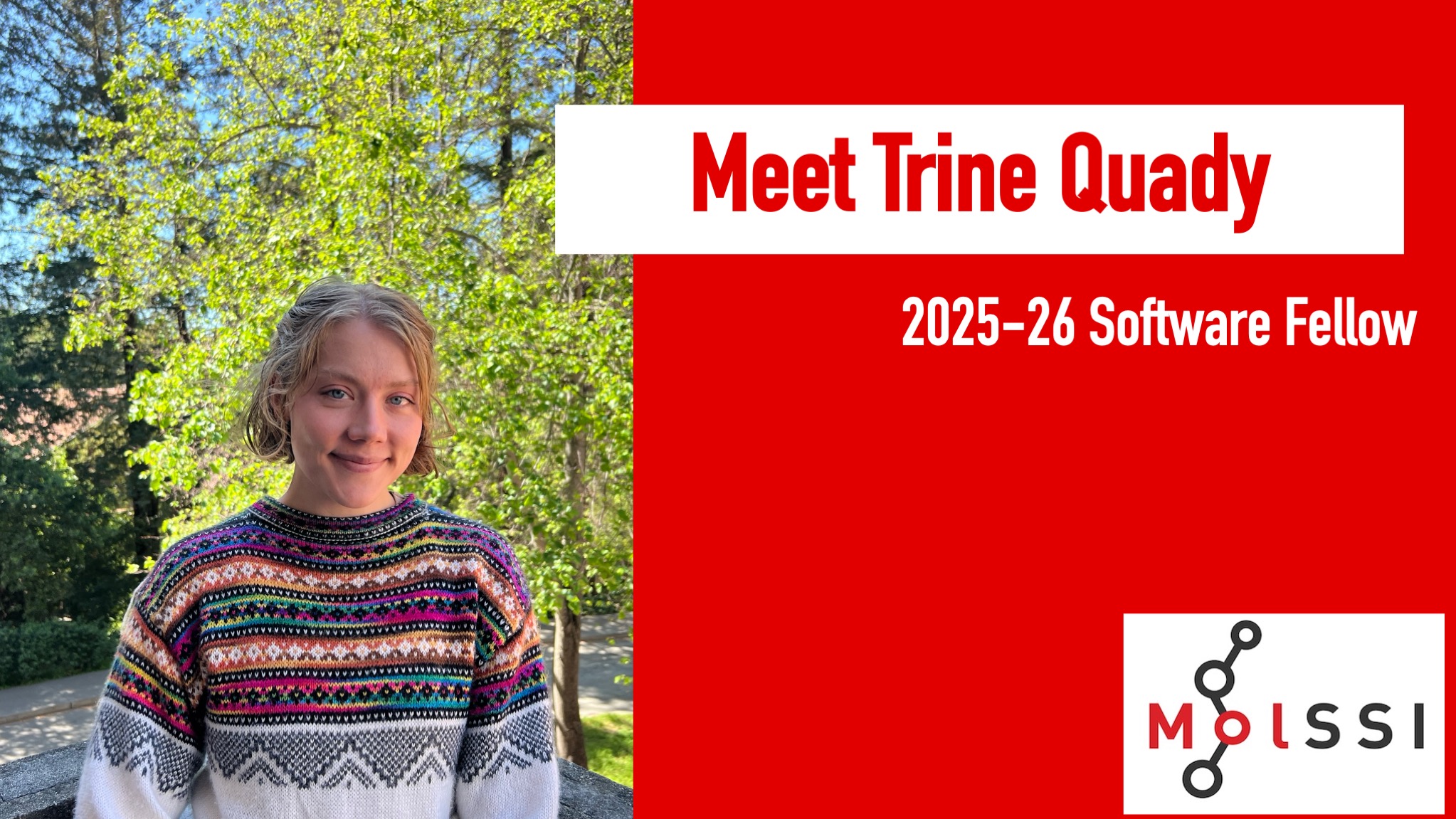
Meet Ms. Trine K. Quady: A Rising Star in Theoretical Chemistry
From a young age, Ms. Trine K. Quady has been intrigued by the world of chemistry. Her fascination began at just eight years old, when she blew out a candle and was mesmerized by the wispy tendrils of smoke swirling through the air. Curious about the behavior of particles, she asked her big sister if it would be possible to predict their movements if one could manipulate the air in the room. Later learning the complexity of this challenge, it foreshadowed her desire to understand the physical world through the lenses of math and chemistry and life long passion for scientific exploration.
Trine credits much of her intellectual growth to the exceptional teachers and mentors she encountered throughout her educational journey. Their encouragement pushed her to challenge herself both as a student and a researcher. Now, as a graduate student at UC Berkeley and a 2025-26 MolSSI Software Fellow, she has had the opportunity to work alongside her mentor, Dr. Taylor Barnes, who has played a pivotal role in her development as a software engineer. Under his guidance, Trine has learned to dissect large software goals into manageable tasks. Their discussions often start with high-level concepts like parallelization and then dive deep into the intricate details of hardware-level operations. This mentorship has broadened her exposure to various software tools, significantly enhancing her skills and knowledge.
The MolSSI Software Fellowship has proven to be a transformative experience for Trine, enriching her understanding of software sciences. The collaborative environment allows her to engage in meaningful conversations with her fellow software fellows, often starting from familiar ground and evolving into comprehensive discussions about software practices and hardware specifics. This supportive community has made tackling research challenges feel more achievable, providing invaluable guidance along the way.
Trine’s current research focuses on the implementation and acceleration of a local second-order Møller-Plesset Perturbation theory (MP2) code. Unlike traditional implementations, her local-MP2 code is tailored to calculate energy differences between two molecules, specifically targeting energy variations during conformational changes. By optimizing the correlation treatment in similar regions of the geometries, she aims to achieve rapid, difference-matched local MP2 energy calculations. While the theoretical speed-up is promising, the practical implementation poses significant software challenges, underscoring the vital role of the MolSSI fellowship in her journey.
Looking ahead, Trine aspires to become a professor of theoretical chemistry at a research-intensive university. She is passionate about both research and mentoring, believing that academia is the perfect setting for this blend. One of her greatest hopes is to teach a graduate-level quantum mechanics course, a subject that profoundly shaped her own academic path.
When she’s not immersed in the world of chemistry, Trine enjoys indulging her culinary skills, particularly in making “a mean croissant.” She is also an avid runner, having completed her first marathon last October and she plans to tackle the Taco Bell 50k this coming October. Professionally, she’ll complete her PhD and pursue a post-doctoral position.
Follow Trine’s journey and explore her work as she continues to make strides in the field of theoretical chemistry!
Check out her GitHub if you are interested in more of her work